Instrument Comprehension Test (INSC)
Instrument Comprehension Test (INSC)
The INSC presents aircraft instrument readings and requires you to match them to either a visual aircraft orientation or a written statement, testing your ability to extract and cross-reference flight data under time pressure.
Part 1
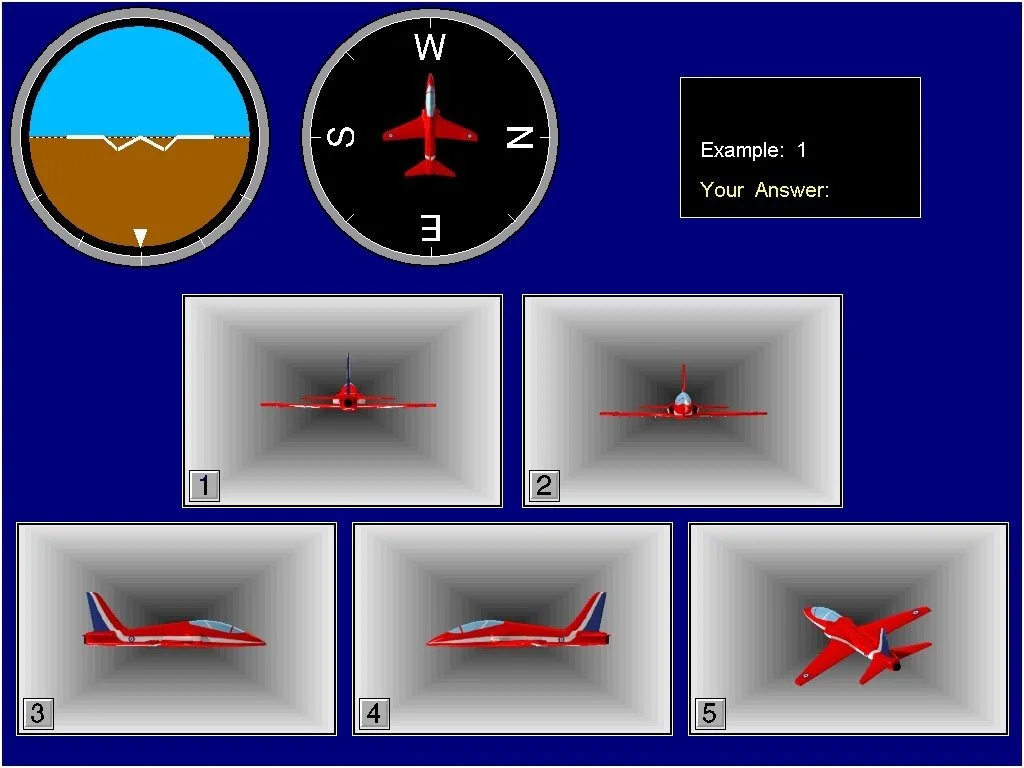
Part 1 places two instruments at the top of the screen and four aircraft images at the bottom; your task is to identify which image correctly represents both readings simultaneously.
The left instrument is an Attitude Indicator. It displays the aircraft's pitch and roll through a horizon line: the blue area represents sky, the brown area represents ground, and a white wing-shaped marker at the centre represents the aircraft itself. Similar to a spirit level mounted across a windscreen, the marker's position relative to the two fields tells you exactly how the aircraft is oriented in space. The right instrument is a compass showing the direction the aircraft is facing, expressed as a cardinal or intercardinal heading.
The Attitude Indicator holds three observable states before you interact with it. When the white wings sit centrally between equal blue and brown fields, the aircraft is level: neither ascending nor descending, neither banking left nor right. When the wings tilt, the aircraft is banking in the direction of the tilt. When the blue field expands downward or the brown field expands upward, the nose is pitching down or up accordingly.
Worked example: the Attitude Indicator shows white wings centred horizontally between equal blue and brown fields; the compass needle points to W. You must infer: level flight (no pitch), no bank (wings are straight), heading West. If the wings are level and the compass reads West, then the correct image shows a straight, horizontal aircraft facing West. If an option shows banking or a different heading, eliminate it immediately. One image remains.
When the Attitude Indicator shows the blue field dominating the lower half of the display, you must read this as the nose pointing downward. When the wings tilt right, you must read this as a right bank. Apply both conditions simultaneously and reduce the four options to one.
Part 2
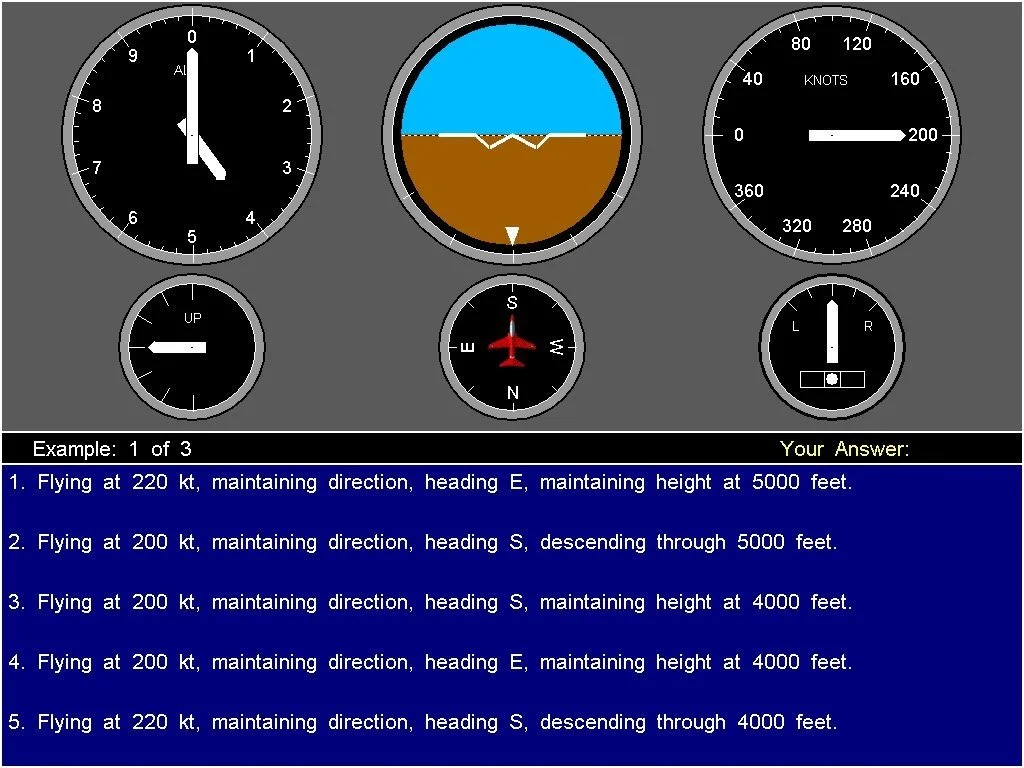
Part 2 presents six instruments and five written statements; you select the one statement that correctly describes the combined instrument readings.
The six instruments occupy two rows of three. The Altimeter (top left) shows altitude: the small hand measures thousands of feet and the large hand measures hundreds of feet. The Attitude Indicator (top centre) functions identically to Part 1. The Speed Indicator (top right) displays airspeed in knots. The Ascend/Descend Indicator (bottom left) reads level when its needle rests at the fourth marker from the top; above that point indicates ascent, below indicates descent. The Heading Indicator (bottom centre) is a compass displaying the aircraft's current bearing. The Turn Indicator (bottom right) shows turn direction and rate: when the white dot beneath the needle rests centrally, the aircraft is in a standard-rate turn; when the dot shifts left or right, the turn is non-standard.
The five statements are presented before you read any instrument, and this sequencing defines your time strategy. Read the statements first. The statements declare which data points differ between them, and this tells you precisely which instruments to check and in which order.
Worked example: the five statements open with speed figures. Statement 1 lists 220 knots; Statement 5 lists 220 knots; the Speed Indicator reads 200 knots. If the instrument reads 200 knots and two statements list 220 knots, then Statements 1 and 5 are eliminated before you touch any other instrument. Move to the next data point where the remaining three statements diverge, such as altitude or heading. Scan. Match. Eliminate. Repeat until one statement remains.
When a data point appears identically across all remaining statements, skip that instrument entirely and move to one where the statements diverge. When only one statement survives all eliminations, that is your answer, regardless of how many instruments you have not yet verified.
Top Tip: Never begin with the instruments. Begin with the statements, identify the data points that differ between them, and build your elimination sequence before you read a single dial. On questions where five data points are listed but only two vary between statements, you will answer correctly having checked two instruments instead of six.
Reading the mechanics is passive; passing requires active cognitive endurance.
DRT Module is under development for now, stay tuned for updates and move to the next guide: Numerical Operations Test (NOT).