Rapid Tracking Test (RTT)
Rapid Tracking Test (RTT)
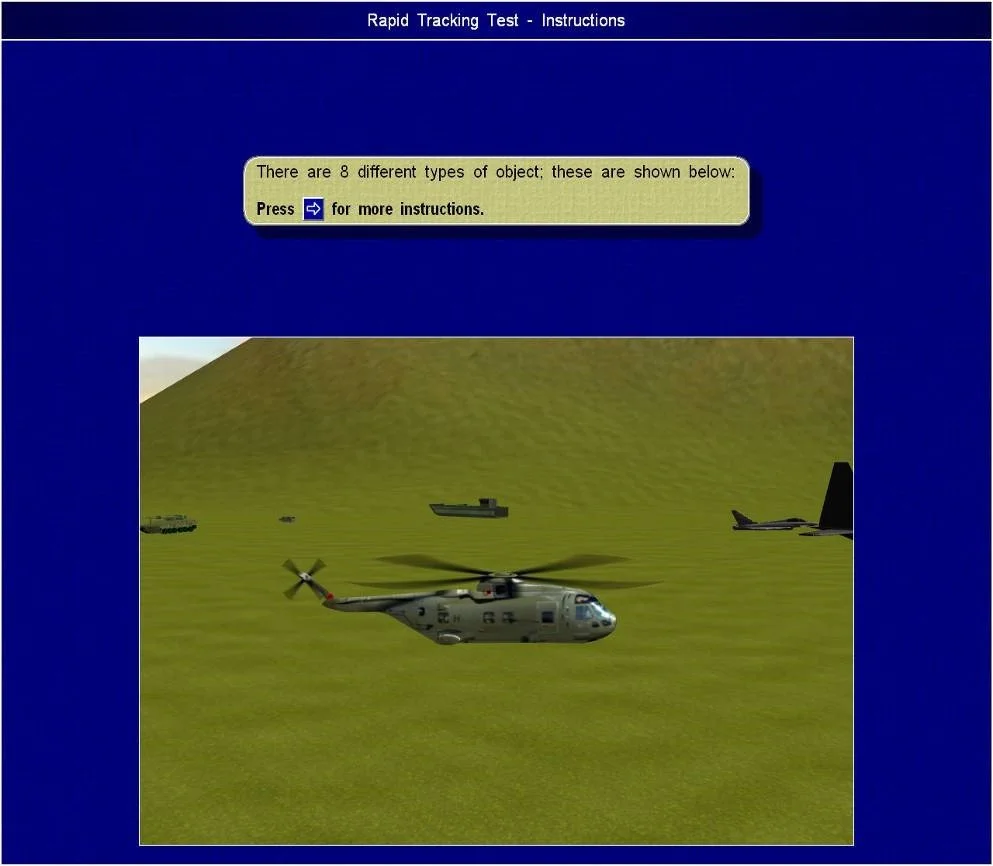
The Rapid Tracking Test gives you a joystick, a first-person aircraft camera feed, and a series of targets you must photograph three times each before they disappear or change.
The Interface and Components
You sit at a station with a joystick. The screen shows a continuous video sequence from inside an aircraft cockpit perspective. A crosshair or central frame marker sits at the centre of the display. Targets appear within this live feed at varying distances, speeds, and trajectories. The joystick controls the direction of the camera. The trigger on the joystick captures a photograph. Three captures per target are required to register a successful track.
Target Behaviour
Targets do not wait. A stationary object, such as a fixed structure on the ground, presents the minimum challenge: it holds position and you adjust the camera to centre it. A slow-moving person or land vehicle drifts across the frame at a pace that requires continuous micro-adjustment. Fast-moving aircraft cross the frame quickly and demand rapid, smooth joystick input to hold the crosshair on target. All targets can pass behind obstructions, at which point they temporarily disappear from view. The test is designed to overload you; the measure is where your tracking degrades, not whether it ever does.
Worked Example: Predicting Through Obstruction
A land vehicle is moving left to right at moderate speed. You have captured two photographs. The vehicle passes behind a building and disappears. You must not freeze. The vehicle was moving at a consistent rate, left to right, so you continue moving the camera in the same direction at the same speed to anticipate its exit point on the other side of the obstruction. When it reappears, your crosshair is already tracking the correct zone. You centre immediately and capture the third photograph. If you stop moving the camera when the target disappears, you will be behind its position when it becomes visible again and you will likely miss the third capture.
Similar to leading a moving target in clay pigeon shooting: you aim ahead of the object's current position, not at it.
Condition and Action: Obstruction
When a target passes behind an obstruction, you must maintain camera movement in the direction and at the approximate speed the target was travelling before it disappeared. When the target reappears, you centre the crosshair and press the trigger to complete the remaining captures.
Condition and Action: Target Change
When the current target is replaced by a new one, you must relocate the crosshair to the new target's position as quickly as possible and begin building your three captures from zero. Do not carry forward time spent on the previous target.
The Joystick Calibration Problem
The joystick provided at the test centre will have its own sensitivity profile, which will not match any controller you have used before. The first moments of the test are your calibration window. Move the joystick in small increments and observe how far the camera responds. If the camera overshoots the target, reduce input pressure. If it tracks too slowly, increase it. You are adjusting to the hardware in real time, and that adjustment is part of the test. Candidates who have practised with similar joystick hardware before the day report a shorter calibration period; the physical habit of analogue input control transfers even when the specific sensitivity differs.
The live test runs at a pace that candidates familiar with third-party practice applications describe as closer to jogging than sprinting. If practice tools felt unmanageable at speed, the actual test is likely more recoverable than your rehearsal suggested.
Difficulty and Expectation
The RTT is not scored on perfection. The test increases demand until tracking degrades; your score reflects where that threshold sits, not whether you ever lost a target. When tracking becomes difficult, you must maintain output on the primary task, keeping the crosshair on the current target, before attending to anything secondary. Composure under overload is the variable being measured.
Top Tip: Do not attempt to snap the crosshair onto a target with a single large joystick movement. Approach the target with a coarse input to close the gap, then switch to fine inputs to centre precisely before triggering. Large corrective inputs on a sensitive joystick create oscillation around the target and waste capture time.
The RTT is under development for now, stay tuned for updates and move to the next guide: Sensory Motor Apparatus Test (SMA).