
System Logic Test (SLT)
System Logic Test (SLT)
The System Logic Test gives you 15 information tabs, two visible at a time, and requires you to locate, combine, and calculate to answer approximately 30 multiple-choice questions within 20 to 25 minutes.
The Interface and Components
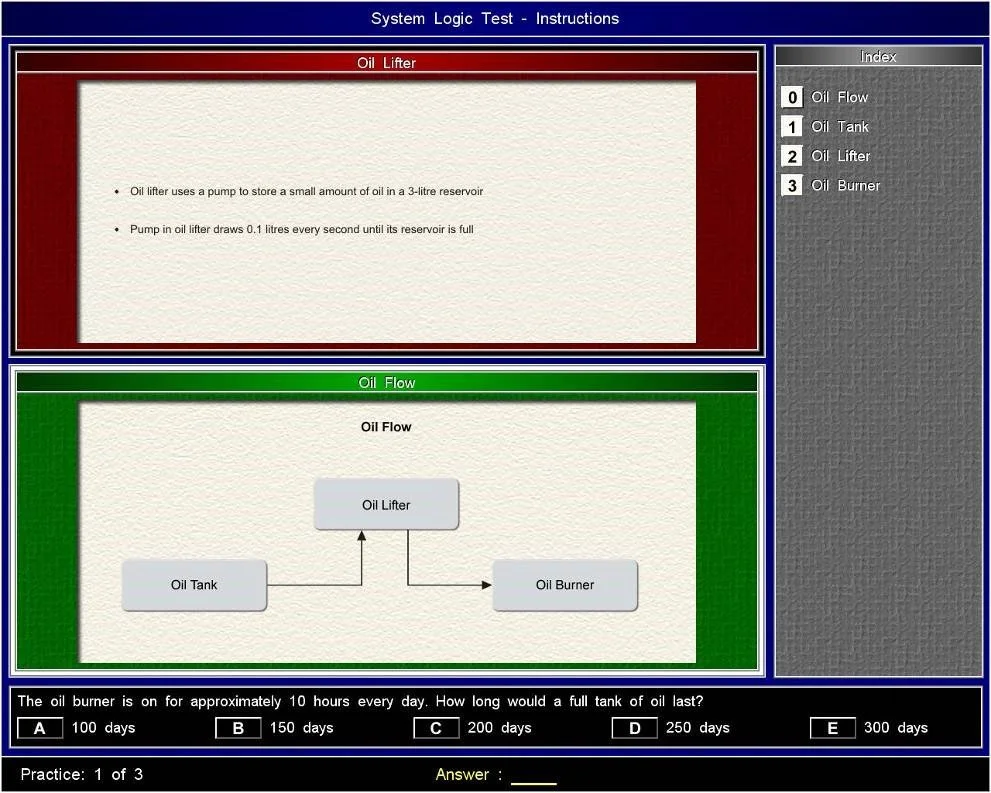
The interface consists of a numbered index panel on the right and a dual-pane display area on the left. The index lists every tab by number and label. The display area renders two tabs simultaneously, and opening a third tab closes the oldest one automatically. In the Oil Flow example shown in the instructions screen, the index contains four entries: Oil Flow (0), Oil Tank (1), Oil Lifter (2), and Oil Burner (3). The Oil Flow tab displays a directional diagram: oil moves from the Oil Tank into the Oil Lifter, and from the Oil Lifter onward into the Oil Burner. The Oil Lifter uses a pump to store oil in a 3-litre reservoir, drawing 0.1 litres per second until that reservoir is full. Each tab holds one category of data. No single tab contains everything the question requires.
The system topic changes each year. A 2020 sitting used a house renovation scenario, with tabs covering room dimensions, perimeter values, boiler specifications, and heating costs. The subject matter changes; the tab-and-index structure does not.
Worked Example
The practice question on the instructions screen reads: "The oil burner is on for approximately 10 hours every day. How long would a full tank of oil last?" with answer options of 100, 150, 200, 250, and 300 days.
The instructions screen confirms two data points: the Oil Lifter stores oil in a 3-litre reservoir, and its pump draws 0.1 litres per second until that reservoir is full. The question requires two further values, the capacity of the Oil Tank and the consumption rate of the Oil Burner, which sit on tabs not visible in the instructions screen. When you enter the live test, those values will be on the Oil Tank tab (index 1) and the Oil Burner tab (index 3) respectively. The structure of the problem is visible even without those values: the question names a daily usage duration and asks for a total duration, which means you must retrieve a total capacity and a consumption rate from two separate tabs, then calculate. If you see a capacity value and a consumption rate stated across two tabs, you must derive daily consumption first, then divide total capacity by that figure to reach the number of days.
Tab Navigation Rules
When a question names a specific component, open the tab for that component first, then identify which secondary value the question requires and open the corresponding tab. When the answer demands a value from a third tab, close one of the two open tabs before navigating to the third. When a tab contains a formula or equation, open it first, because it defines which other values you need to retrieve.
When a question asks for a cost, area, or duration, the question itself signals the required data categories. "Total area cost of the Guest Room" requires a dimensions value and a cost-per-unit value on two separate tabs. Open the area tab, note the dimensions, close it, open the cost tab, apply the stated equation. Similar to a reference book with a fixed index, the system tells you where to look; the cognitive load is in combining what you find.
Top Tip: Before reading any question in detail, scan the full index and mentally group tabs by data type, for example dimensions, rates, costs, and formulas. This takes under a minute at the start and removes navigational hesitation mid-question, because you already know which tab holds which category.
Skipping and Time Management
When a question requires more than two tab lookups to resolve in sequence, skip it and return. When the time limit approaches, you must complete single-reference and two-reference questions before returning to multi-step items. The test permits returning to skipped questions; use that permission structurally rather than reactively.
Practice Available? - Coming Soon
Reading the mechanics is passive; passing requires active cognitive endurance. The SLT places real pressure on working memory: you hold a partial value, switch tabs, retrieve a second value, and calculate, all within a moving time limit. That pressure does not replicate through reading alone. Air Defence Academy is currently developing a practice test for the SLT and will update the CBAT/MACTs Program once released.
Start the Simulator, or move to the next guide: Air Defence Academy CBAT/MACTs Course