Directions and Distances (DAD)
Directions and Distances (DAD)
The DAD test gives you a text description of either a set of fixed spatial relationships or a multi-step journey, then asks you to calculate your final distance or compass direction from a named reference point.
The Interface and Components
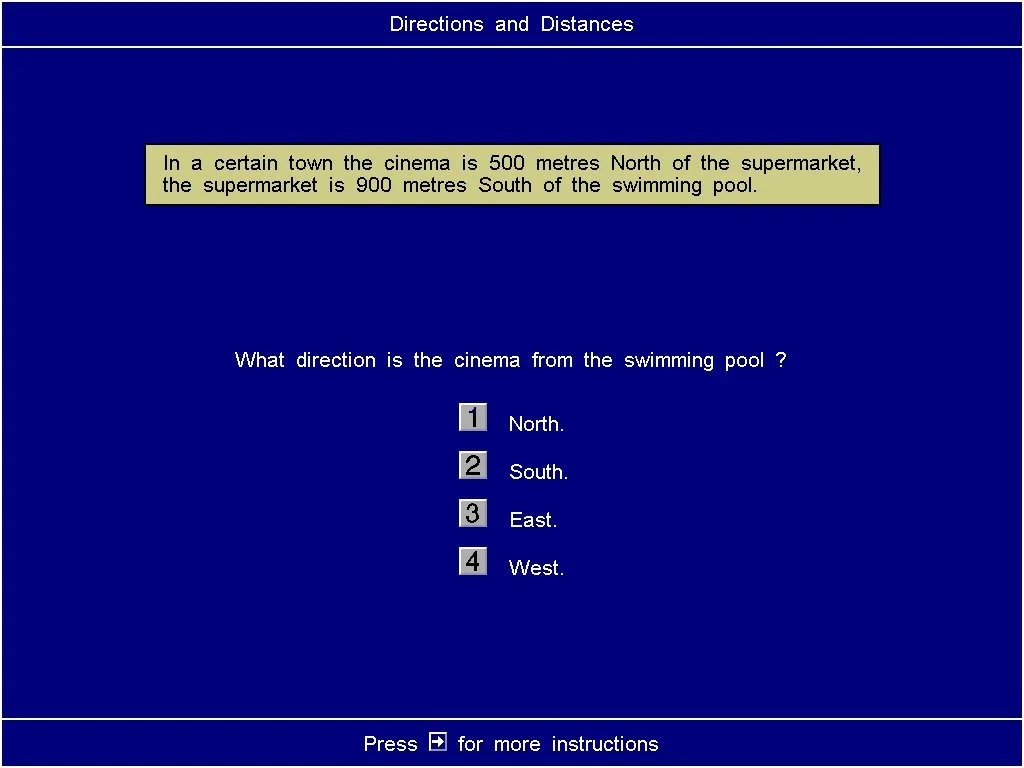
The screen displays a dark blue interface with a title bar reading "Directions and Distances." A yellow-beige text box at the top of the screen contains the passage, and the question appears below it in white text. Four numbered answer buttons (1 through 4) sit below the question; you press the corresponding number to select. A footer bar reads "Press → for more instructions." You cannot return to a question once answered. Two distinct question formats appear in the test: static relationship questions and journey questions.
Behaviour Before You Interact
Static relationship questions describe how fixed locations relate to each other. They do not involve movement; they require you to chain those fixed relationships to determine where one landmark sits relative to a third. Journey questions describe a vessel or person moving through sequential steps, each with a named direction and a distance. Difficulty scales by adding steps, introducing Left turns that return the heading to a previously used axis, and narrowing the gap between answer options. The trap is not the arithmetic; it is mis-assigning a movement to the wrong axis because you tracked axis changes rather than the actual heading.
Worked Example: Static Relationship Questions
In a certain town, the cinema is 500 metres North of the supermarket. The supermarket is 900 metres South of the swimming pool. What direction is the cinema from the swimming pool?
Chain the relationships from the swimming pool downward. The supermarket sits 900 metres South of the swimming pool. The cinema sits 500 metres North of the supermarket, which means it is 900 minus 500 equals 400 metres South of the swimming pool. If you see A (a chain of named relationships between landmarks) and B (a direction question between two non-adjacent points), you must infer C (resolve the chain to a net offset, then read the sign as your direction). The answer is South.
Worked Example: Journey Questions
A ship leaves the harbour and sails West for 800 miles, turns Right and sails 800 miles, turns Left and sails 700 miles. How far is the ship from the harbour?
Read one move at a time. Do not read ahead.
West 800. Hold that: you are 800 West.
Right. Right from West is North. Sail 800. Hold that: you are 800 West and 800 North.
Left. Left from North is West. Sail 700. West again: add it. You are now 1500 West and 800 North.
Two numbers. That is all you need. Call the larger one L (1500) and the smaller one S (800). The true distance from the harbour is always greater than L and always less than L+S, so it falls somewhere between 1500 and 2300. Scan the four options and eliminate everything outside that range. The answer at exactly 1700 is the only option that survives.
The answer options are built to catch two mistakes: L+S (2300, for candidates who simply add both axes) and L alone (1500, for candidates who ignore the second axis). The bounding box eliminates both in under a second.
When a Left turn returns your heading to an axis you are already tracking, net the new distance against your running total immediately. In this example, Left from North returned the heading to West, so 700 was added directly to the existing 800 West rather than opening a new column. If you track axis changes instead of actual heading, you assign that 700 to the wrong column and your two final numbers are wrong before you reach the bounding box.
Similar to tuning a dial, Right clicks one position clockwise around N→E→S→W→N, and Left clicks one position back. One click per turn, applied the moment you read it, before moving to the next distance.
Try for free, no login required, at Air Defence Academy's CBAT/MACTs Directions and Distance (DAD) module.
The Condition
When a question chains static landmarks, you must resolve each named relationship in sequence, summing offsets along a single axis, then reading direction from the sign of the net value. When a journey question contains any combination of Right and Left turns, you must click the heading dial one position per turn before assigning its distance to an axis. When a new movement lands on an axis already carrying a value, net it immediately. When the bounding box eliminates all but one answer option, select it. When two options survive, select the one closer to L.
The Action
For static relationship questions, place the landmark named in the question at zero on a mental number line, add each offset with its sign (North and East positive, South and West negative), and read the result. For journey questions, click the dial on each turn as you read, assign each distance to its axis, net immediately on collision, then apply the bounding box to the answer options. Do not reconstruct the passage. When the time limit approaches, you must commit to the two live numbers you hold and apply the bounding box rather than restart.
Top Tip: Read each turn and convert it to a heading before reading the next distance. Candidates who batch all turns together at the end introduce ordering errors. Converting turn-by-turn keeps one live heading in working memory at all times and prevents the Left-turn trap, where a heading returns to a previously used axis and its distance must net against an existing value rather than open a new column.
Reading the mechanics is passive; passing requires active cognitive endurance. Access the precise training simulator in the Air Defence Academy's free CBAT/MACTs Directions and Distance (DAD) module.
Start the Simulator, or move to the next guide: Dynamic Projection Test.