
Digit Recognition Test (DRT)
Digit Recognition Test (DRT)
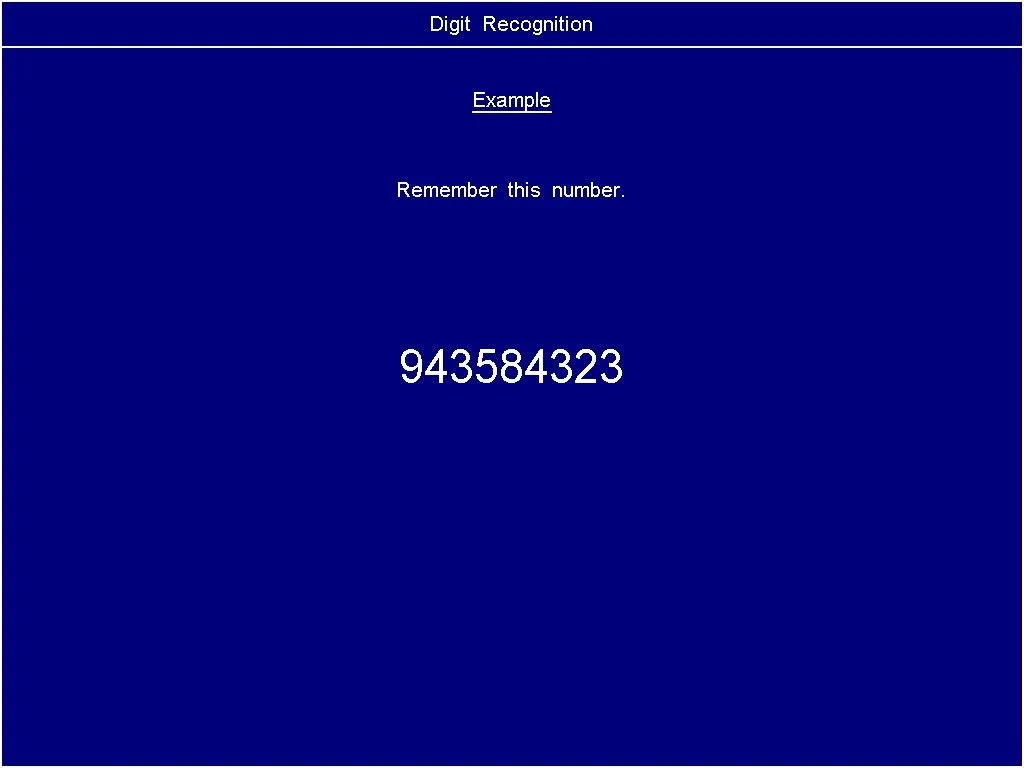
The Digit Recognition Test gives you a string of digits on screen for five seconds, removes it, and asks you to report how many times one specific digit appeared.
The Interface
The screen displays a single horizontal string of digits. No other information is present during the display phase. When the string disappears, a multiple-choice question replaces it, and you select a number from the options provided. The question format does not vary: it always targets the frequency of one digit within the string you just saw.
Behaviour
The test scales upward in one dimension: string length. Strings begin at approximately five digits and increase to approximately fifteen digits as you advance. The question format, the five-second display window, and the multiple-choice answer structure remain constant throughout. The difficulty is produced entirely by the increase in the number of digits you must hold.
Worked Example:
String displayed: 4 4 2 4 1
Question: How many fours were there?
You scan left to right and tag each digit as it appears. Position one: 4, count one. Position two: 4, count two. Position three: 2, no tag. Position four: 4, count three. Position five: 1, no tag. The answer is three. The reasoning chain is: see digit, match to target, increment count, move to next position. At five digits, you can complete this pass in a single scan before the string disappears.
The Condition
When the string is five to eight digits, you hold the full sequence in working memory and run a single left-to-right count on recall. When the string exceeds ten digits, full positional recall fails under the five-second constraint and any count performed after the string disappears becomes unreliable.
The Action
When the string exceeds ten digits, you must switch from full-string memorisation to live frequency tracking. As the digits appear on screen, you run a silent count of every digit that occurs more than once. You do not store positions; you store tallies. When the question appears, you read off the tally for the digit named. If the digit asked about did not register as a repeater, the answer is one or zero, and you select accordingly.
Top Tip: When the string reaches twelve or more digits, fix the counts of the high-frequency digits first, in the final two seconds of display. Digits that appear only once are recoverable by elimination if the question targets them; digits that appear four or five times are not, and losing that count forces a guess on the most consequential answers.
Scoring Context
The DRT is a short-term memory measure with a fixed-format question structure. The test does not reward speed of response after the display phase; the entire cognitive load is concentrated within the five-second window. Performance is determined by what you extract during display, not by how quickly you answer afterward.
Reading the mechanics is passive; passing requires active cognitive endurance under a fixed time window with a string length that will exceed comfortable working memory.
DRT Module is under development for now, move to the next guide: Directions and Distance (DAD).